Conduction, Convection and Hybrid in Vaporizers Explained
Short answer: Conduction transfers heat through contact, convection through flowing hot air. Hybrid devices combine both pathways. From this alone, neither a fixed THC yield nor better flavour or a reduced health risk can be derived. What matters is the specific device, its regulation and the conditions of use. The relevant laboratory comparisons test individual models, not representative heating classes. [Lanz2016] [Carrara2020]
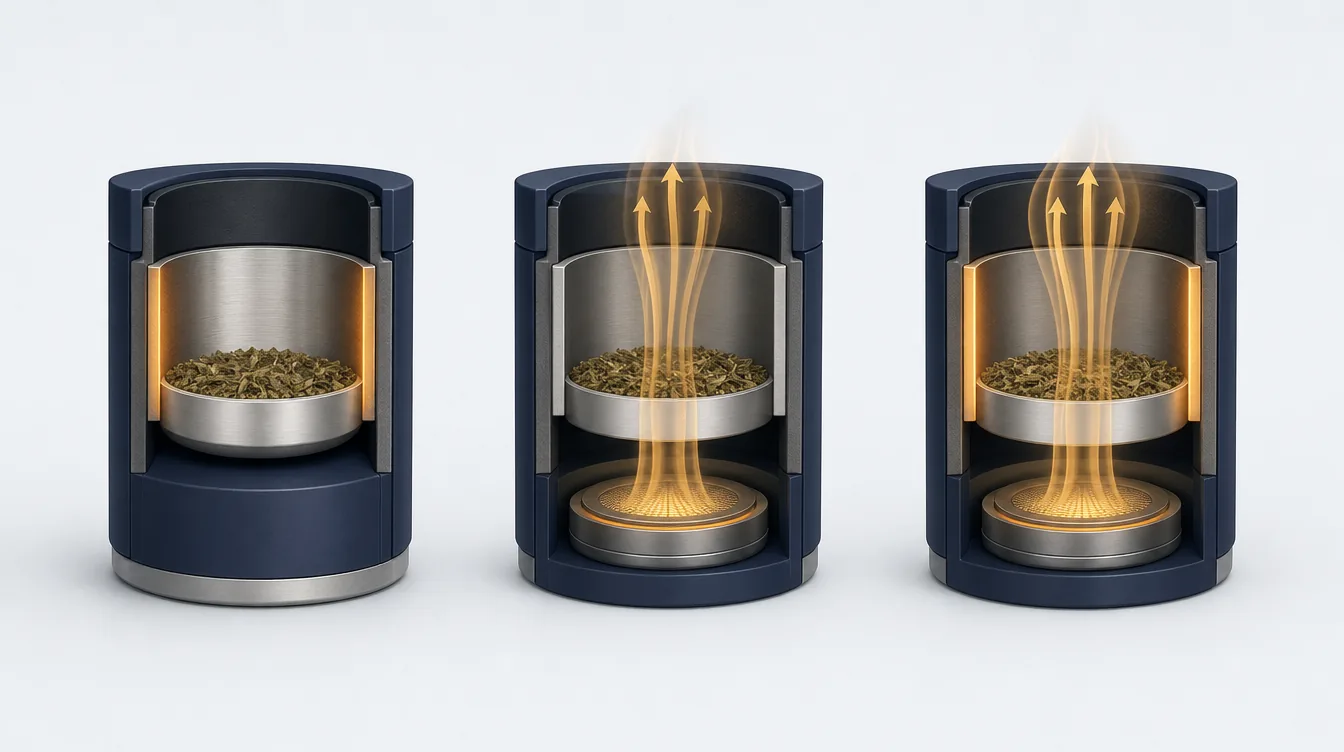
What the three terms actually describe
A vaporizer must transport energy from the heater into the plant material. The designation of the heating method describes the predominant transport pathway. It initially says little about how evenly the entire load is heated, how quickly the regulation responds, or how much cannabinoid reaches the mouthpiece.
With conduction, a hot surface heats the material it is in contact with. Heat then also travels further within the load. The geometry of the chamber and the contact with the wall therefore influence behaviour. However, a tightly packed chamber does not automatically increase the usable delivery: it can simultaneously alter the airflow. The correct way to fill the chamber depends on the specific device.
With convection, heated air transports energy through the load. Air throughput, flow distribution, heating power and time all act together. A very free draw is no guarantee of a particularly complete extraction. If air preferentially flows past certain areas, other regions are reached less intensively. The advertising claim of “pure convection” therefore does not replace a measurement of temperature distribution.
With hybrid heating, both pathways contribute deliberately to the heating. No universal mixing ratio follows from this. A device may operate differently during heat-up than during a draw. Even in a system marketed as a convection device, hot chamber walls can transfer heat through contact. The classification is a technical simplification, not a precise law of nature.
These explanations are a physical categorisation. Statements about the performance of specific products additionally require model-specific measurements or manufacturer documentation. Zwölferpool does not provide a current classification of all devices.
Heating methods compared: characteristics and open measurement questions
| Characteristic | Conduction | Convection | Hybrid |
|---|---|---|---|
| Primary heat transport | Contact with the hot surface | Heated air through the material | Combination of both pathways |
| Key influencing variables | Chamber geometry, contact, thermal mass | Air throughput, distribution, heating reserve | Interplay of chamber and air heater |
| Behaviour during pauses | Dependent on stored heat and regulation | Dependent on which parts remain hot | Dependent on the specific operating mode |
| Meaningful evidence | Temperature and delivery measurement on the model | Temperature and delivery measurement on the model | Temperature and delivery measurement on the model |
| Not derivable from the label | Fixed yield or contaminant ratio | Freedom from losses or medical superiority | Automatically better overall performance |
The table categorises operating principles. It is not an experimentally determined ranking. In particular, blanket efficiency ranges for the three columns are not scientifically justified.
Why “efficiency” requires a definition first
In everyday use, efficiency can mean consuming little plant material, conserving the battery, or emptying a load quickly. In the laboratory, it can refer to the proportion of a cannabinoid that is recovered in a particular collected fraction. These questions have different units and denominators.
Cannabinoid recovery describes an analytical recovery figure. It must be clear whether only the collected aerosol is measured, or whether condensate on device surfaces and residues in the chamber are also captured. A high total recovery across several fractions does not mean that this entire quantity was delivered in inhalable form at the mouthpiece. [Lanz2016]
Extraction rate describes the temporal progression. Two devices may deliver a portion of their total quantity at different points in time. A steeper progression does not automatically mean a higher final yield. Still less can an equal effect per draw for every person be derived from this. [Carrara2020]
Decarboxylation is the chemical conversion of a cannabinoid acid into the corresponding neutral form. It is not equivalent to transport out of the chamber. A converted cannabinoid may still be present in the plant residue or on a device surface. [Lanz2016]
Bioavailability concerns the proportion of an administered dose that reaches the systemic circulation. This is a pharmacokinetic measure. A filter at the outlet of a puffing machine is not a human organism. A device recovery must therefore not be referred to as bioavailability.
What the direct laboratory comparisons contribute
Lanz and colleagues examined five models of the time with different technical concepts. The work captured the delivery and conversion of cannabinoids as well as residues. Its strength lies in analytically distinguishing these sub-quantities. Its limitation lies in the selection of devices examined and the respective experimental conditions. [Lanz2016]
Carrara and colleagues developed a measurement set-up for portable flower vaporizers. Two models were compared under a fixed draw regime. The differing delivery profiles show why an identical display setting does not yet mean an identical dose at the outlet. They provide no evidence that every representative of one heating class surpasses every representative of another class. [Carrara2020]
For a statement about heating classes, numerous models per class would need to be selected meaningfully and examined under comparable conditions. Even within a single model, several device units and loads would be required to assess manufacturing and sample variation. Many measurements on a single load do not substitute for this breadth.
Why the display temperature is not a common comparison scale
A temperature sensor measures at its installation point. This may be a heating element, an air channel, or a chamber wall. The temperature inside the flower load can deviate from this both over time and spatially. A display is therefore primarily the readout of the respective control system.
During a draw, air flows in and transports heat. How strongly the measured temperature fluctuates in the process depends, amongst other things, on heating power, air volume and regulation. At rest, heat from hot components can continue to travel into the load. A single measurement value before the first draw does not describe the complete progression.
A fair comparison therefore requires information on sensor location, load, airflow and measurement time point. “Both set to the same number” is a sensibly documentable condition, but not yet an equality of material temperature. More on this in the article on cannabinoid boiling points and device displays.
Session and on-demand are a different classification
Session generally describes an operating mode in which the device is kept ready over a time window. On-demand describes activation according to need. Both concern the control. Conduction and convection, by contrast, concern heat transport.
The common association of conduction with session and convection with on-demand is not a mandatory assignment. Even a heating element activated on demand can leave components warm. Conversely, a session mode can supply more or less heat through regulation. The terms answer different questions and should be examined separately when making a purchase.
Anyone who frequently interrupts their use should therefore enquire about the actual pause behaviour of the model. Anyone assessing several consecutive draws needs information on re-heating and delivery consistency. The in-depth session/on-demand comparison explains the limits of economy and dose claims.
The role of grind size, load and draw
The load is part of the heat exchanger. Different particle sizes alter contact surfaces and flow paths. Very fine particles can place greater demands on screens or air channels; very different particle sizes make reproducible comparisons more difficult. No universal optimal grind size for all chambers follows from this.
The same mass does not necessarily mean the same packing density either. Chamber shape, moisture content, and material structure influence how the filling sits. Anyone documenting settings should therefore note not only the mass but also the material batch, preparation, and capsules used.
The draw is also a measurement condition. Duration and air volume are two different quantities: draws of equal length can move different volumes of air. A draw machine can control this; subjective descriptions such as ‘slow’ or ‘strong’ remain less precise. This is one reason not to convert laboratory results directly into everyday savings.
A Systematic Approach to Comparison
For personal device assessment, observable properties are the most appropriate starting point: operation, stability, access for cleaning, compatibility, heat-up indicator, and standby behaviour. These points can be documented separately from non-measurable active-substance delivery.
In a published device test, baseline conditions should be established before the comparison. Observations for each device are then recorded. Anyone who changes fill quantity, grind size, and temperature setting simultaneously during a test cannot subsequently attribute differences to any single factor.
Sensory impressions may be described as such. ‘More pleasant for this person’ is a different statement from ‘chemically cleaner’. A subjective taste test cannot confirm purity without analytical measurement. Likewise, the colour of the residual material is not a reliable measure of the remaining THC mass.
How to Recognise a Reliable Heating-Method Statement
A sound comparison names the model and version, plant material, loading, temperature definition, draw regime, collection method, and outcome measure. It explains how many independent loadings and devices were examined. For percentages, the denominator is visible; for means, the spread is given or the omission of figures is explained.
A weak comparison skips these steps and cites only the highest percentage figure from a single study. It is particularly problematic to replace a historical device name with the name of a current successor model. The same brand logo does not mean identical heating, software, or airflow.
For a purchasing decision, technical fit and documented model characteristics are therefore more useful than a purportedly scientific winning category. Prices and scope of delivery remain separate, time-dependent product data. A study on THC delivery assesses neither current value for money nor a manufacturer’s service.
Example: Why Three Measurements Are Not Three Device Series
Lanz describes experiments with 50 mg of plant material in triplicate per device and cannabis variety. Standards and various collected fractions were also examined. These details belong to different levels of the experiment. Three loadings are not the same as three different models or three independently drawn samples from the entire market. [Lanz2016]
If the same extract is injected into an analytical instrument multiple times, this primarily tests analytical repeatability. If three new loadings are prepared, the variability of loading is added. If several physical device units are examined, unit-to-unit variability can additionally be estimated. These levels should be visible in a scientific summary.
Analysing multiple cannabinoids likewise does not multiply the number of independent devices. THC and CBD from the same loading share many experimental conditions. An article should therefore not derive the claim ‘hundreds of independent tests’ from a long table when in reality few experimental set-ups were examined with many measured variables.
For generalisation to a heating category, the selection of models is also crucial. If only particularly popular or readily available devices are examined, this selection must be described. It can answer a useful device-specific question but is not automatically representative of all products with the same heating designation.
Translating a Result Accurately into Everyday Language
A precise formulation might read: ‘Under the documented laboratory protocol, a higher quantity of the cannabinoid under investigation was found in the output fraction for this model.’ It names the comparison, the outcome measure, and the limitation. The sentence does not yet contain any judgement about flavour, battery, cleaning, or health.
The stronger formulation ‘This heating method fundamentally extracts more from every bud’ would make several additional transfers: from model to category, from the sample to all plant material, and from a measured fraction to an undefined everyday benefit. Each of these steps would require additional data.
When reading a test report, it is therefore worth mentally translating the brief promotional statement back into its underlying measurable question. If device, condition, or endpoint are missing, the statement is closer to an opinion than a scientific description of results.
Addition from the Terpene Audit
The device and method sources cited above were retained when consolidating the current version of the article. The following sections supplement the separate terpene audit with targeted source verification. Neither literature selection constitutes a systematic comprehensive search.
What Would a Comparison of Heating Principles Need to Look Like?
For the clearest possible attribution, the remaining conditions would be controlled: identical source material, comparable geometry, the same loading, a defined airflow, and a traceable thermal profile. It would then need to be explained which variable the experiment changes and what it measures.
Independent replications and variability are just as important as the mean. A single favourable run does not prove reproducible superiority. If different devices are used, the result must be described accordingly as a comparison of those devices.
For a sensory comparison, further questions arise: who is making the assessment, are the devices identifiable, in what order are they tested, and what scale is used? A subjective taste impression must not be presented as evidence of chemical purity.
How Does One Choose Based on Verifiable Criteria?
Examine the characteristics of the specific device: intended application, comprehensible operation, accessible cleaning parts, suitable spare parts, and the desired operating mode. These details are often more informative for the decision than a blanket label such as ‘pure convection’.
For a scientific statement, appropriate data are then what count. A manufacturer’s statement describes the product first and foremost. A practical test documents an experience. A laboratory experiment measures defined quantities. None of these sources should take on the role of another without being clearly labelled as such.
Anyone using medically prescribed products should furthermore not decide on an alternative application based solely on a heating principle. Technical construction and clinically validated administration are different questions.
Frequently Asked Questions About Heating Methods
Is convection fundamentally more efficient?
This cannot be stated categorically without a definition of efficiency and appropriate comparative data. A device comparison initially documents results for the models examined.
Is hybrid always the best combination?
No. Hybrid describes a construction, not universal superiority. What matters is the implementation, operation, and the desired characteristic.
Is on-demand the same as convection?
No. On-demand describes the temporal mode of operation; convection describes the heat transfer pathway. These terms must be kept separate.
Does a precise display mean a precise dose?
No. The resolution of the display is not a measurement of the quantity of substance delivered and absorbed.
Does Lanz establish general percentage values for heating categories?
No. The study examines specific complete devices and is not a controlled comparison of the heat transfer principle alone.
Source Status and Correction Notice
Revised on 10 September 2026. Scientific reference: Lanz et al., DOI 10.1371/journal.pone.0147286. The classification of technical terms and the comparative logic are editorial.
Unsupported general efficiency ranges and the causal derivation of a superior heating category from a comparison of a small number of complete devices have been removed. The criteria presented are neither proprietary measurement data nor therapeutic efficacy claims.
Studies, References, and Limits of Evidence
The study cards describe the respective experimental design and its limitations.
Lanz2016: In-vitro validation of Volcano Medic, Plenty, Arizer Solo, DaVinci and Vape-or-Smoke with THC- and CBD-containing plant material as well as standards.
Lanz C, Mattsson J, Soydaner U, Brenneisen R. Medicinal Cannabis: In Vitro Validation of Vaporizers for the Smoke-Free Inhalation of Cannabis. PLOS ONE. 2016;11:e0147286.
- Design and material/population
- In-vitro validation of Volcano Medic, Plenty, Arizer Solo, DaVinci and Vape-or-Smoke with THC- and CBD-containing plant material as well as standards.
- Sample units
- Five models, not five clinical groups. The replicates per experimental condition are technical replicates; different sample types and measurement fractions must not be combined into a single total.
- Measurement
- HPLC/GC-MS; investigation of cannabinoid recovery, residues and decarboxylation. Electrical devices were tested under defined temperature conditions.
- Finding
- Cannabinoid recovery differed between the specific devices. Combustion was observed in the gas-powered Vape-or-Smoke that was examined.
- Uncertainty and transferability
- Recovery, decarboxylation and losses at device surfaces are separate measured quantities. No direct measurement of lung deposition, blood levels or long-term disease outcomes.
- Funding and interests/design notes
- No specific funding; the authors declare no competing interests and explain the subsequent employment/involvement of one author at AiFame/AiLab.
- Specific source location
- Materials and Methods: Vaporization, Sample Preparation and Analysis; Results and Discussion: Recovery of Cannabinoids, Decarboxylation; Table 2 and figure legends.
- Review scope
- Relevant full-text passages reviewed on 10.09.2026.
Carrara2020: Laboratory study with a standardised puffing machine; DaVinci and Mighty Medic; Bediol flowers. No participants.
Carrara L, Giroud C, Concha-Lozano N. Development of a Vaping Machine for the Sampling of THC and CBD Aerosols Generated by Two Portable Dry Herb Cannabis Vaporizers. Medical Cannabis and Cannabinoids. 2020;3:84–93.
- Design and material/population
- Laboratory study with a standardised puffing machine; DaVinci and Mighty Medic; Bediol flowers. No participants.
- Sample units
- Distinguish between device models, loadings and technical replicates. Table 1 assigns the individual experimental series; six trials for the collector comparison in Table 2 are not six independent device populations.
- Measurement
- 150 mg finely ground flowers, 210 °C target temperature; five-second draws in 30-second cycles. Assessment of aerosol collection and temporal cannabinoid delivery.
- Finding
- The two models showed different delivery profiles. A model coefficient describes the extraction kinetics; it is neither bioavailability nor clinical efficacy.
- Uncertainty and transferability
- A single coefficient does not capture the full uncertainty of the device, plant material and draw behaviour. No ranking of all heating classes.
- Funding and interests/design notes
- No financial or competing interests declared; Storz & Bickel provided the Mighty Medic.
- Specific source location
- Pp. 86–88: Materials and Methods, Tables 1–2; pp. 89–91: Results and delivery model; p. 92: Acknowledgements/Disclosure.
- Review scope
- Relevant full-text passages reviewed on 10.09.2026.
Reviewed source · DOI: 10.1159/000505027
Source review: 10 September 2026. In the targeted pool of twelve primary works, eleven were checked against relevant full-text passages. For Van Dam 2010, accessible original sections beyond the abstract were additionally verified; a complete PDF and table review remains open. Further literature cited in the article belongs to separate source reviews. No systematic comprehensive search.