Diffuser vs. Injector for Ball Vapes: Design, Bowl and Evidence Base
Short answer: In ball vapes, diffuser and injector primarily describe different configurations of the connection between the heating head and the bowl. What matters for the actual effect on the airpath and contact heat is the real geometry. The pool of twelve primary studies provided contains no direct comparison of construction types. Neither fixed yield advantages nor a health-related ranking can be derived from this.
Current offers from our partner shops
All prices come from automated shop queries. Some shop links are affiliate links.
Why the terms must be clarified first
These product terms are not a standardised scientific experimental classification. Manufacturers may use them differently. Before comparing two devices, a description of their physical connection is therefore required.
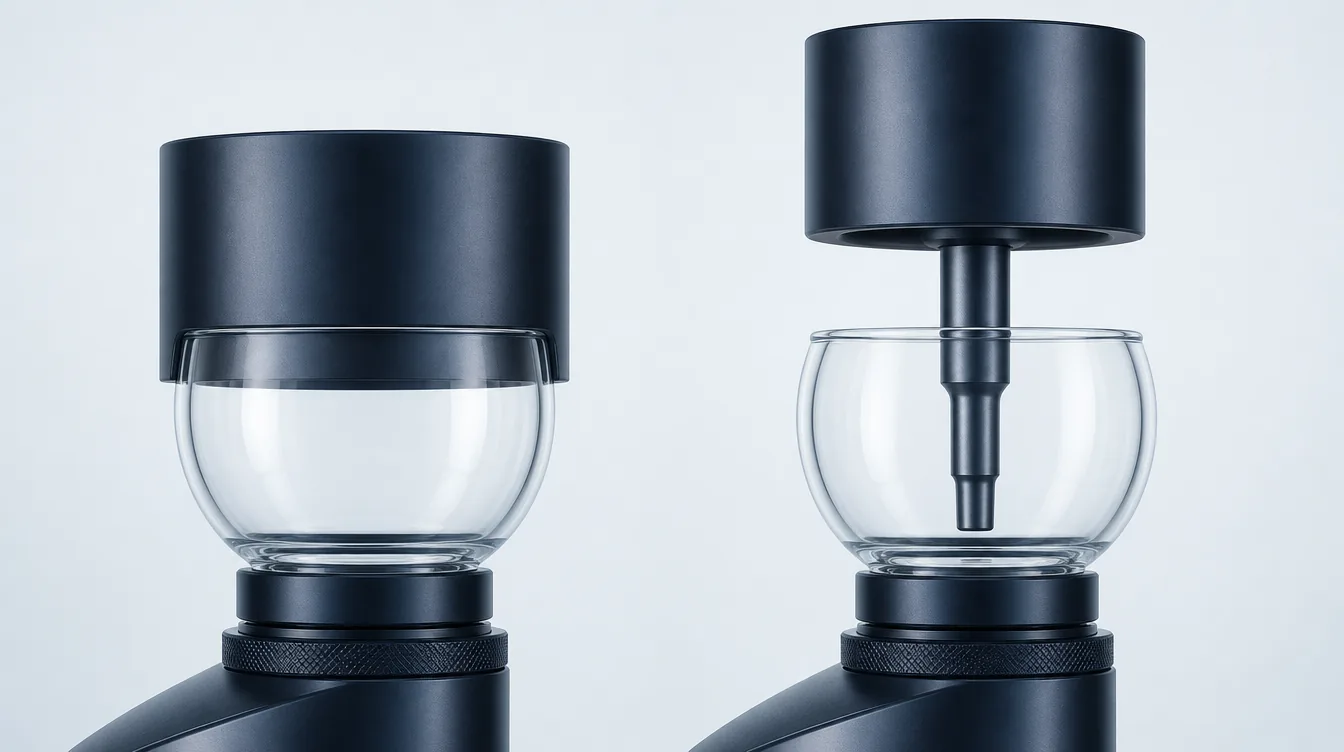
In a typical injector design, part of the heating head fits into the designated bowl connection. The air is directed through this transition towards the fill. In many designs referred to as diffusers, the head sits differently on or around the bowl and may additionally involve outer surfaces thermally.
This description is a technical orientation, not a complete classification of all current models. A concrete assignment must be made on the basis of the manufacturer’s drawing, instructions, or documented construction. Without this check, no product names are assigned here to a supposedly fixed winning category.
Comparing four properties instead of a label
| Property | Concrete test question | Limitation of the statement |
|---|---|---|
| Geometry | Where does the head sit, how far does it extend inward? | Category name alone does not describe dimensions |
| Contact | Which surfaces are in contact during operation? | More contact is not automatically better delivery |
| Airpath | Where does air enter and how does it reach the fill? | Free draw is not a THC measurement |
| Operating procedure | How long do the head and bowl remain together? | The same material can behave differently under a different procedure |
These questions allow a product to be assessed far more precisely than with “diffuser stronger, injector gentler”. Such brief sensory judgements may describe personal experiences, but cannot replace universal measurement results.
Convection and contact heat can occur simultaneously
When air flows through a hot head, it can carry heat to the fill. If at the same time a hot component touches the bowl, a further heat pathway is created. Which contribution predominates depends on time, temperature differentials, and contact surfaces.
A bowl can therefore warm up during operation, even when the system’s primary function is described as using hot air. After removing a head, heat may remain in the bowl. This behaviour cannot be predicted from the name of the connection alone.
The terms conduction, convection, and hybrid are helpful for physical description. However, they do not justify blanket percentage ranges. Quantitative statements require measurement data from the complete combination.
What the bowl contributes to the outcome
The bowl is part of the system. Its material, wall thickness, the position of the screen, and the fill geometry all influence the thermal and fluid-dynamic setup. Comparing two heating heads with different bowls therefore changes more than just the connection type.
Insertion depth can also be relevant. It determines clearances and can affect the available cross-section. A nominally matching joint does not mean that every bowl produces the same distance between the heater and the plant material.
When making a purchasing decision, a manufacturer-approved head/bowl combination should therefore be verified. An incompatible combination cannot be justified by invoking general vaporizer research. The studies do not examine arbitrarily assembled systems.
Why the same controller number is not a fair temperature comparison
The controller regulates based on a sensor. This sensor may be situated far from the plant material. Between the sensor, head, air, and bowl there are several heat-transfer interfaces. The display is therefore not automatically the relevant temperature at the point of extraction.
With different heads, the same set-point values may result in different material temperatures. Pre-heating time and the duration of contact with the bowl also alter the state. A comparison that does not document these factors leaves important causes unaccounted for.
For a reliable evaluation, the sensor location, pre-heating procedure, airflow, and measurement point must therefore be described. The article on boiling points and temperature measurement explains why substance data do not directly prescribe a controller value.
Which efficacy claims are unsubstantiated
The pool of twelve studies contains no direct comparison substantiating a specific additional THC proportion for diffusers over injectors. Equally absent are direct clinical data classifying either type as healthier.
A claim about fundamentally better flavour also requires an appropriate sensory study. A stronger impression can have several causes and, without chemical measurement, says nothing reliable about purity or the mass of cannabinoids delivered.
The absence of a direct comparison in the pool is not a worldwide research statement. It is a clear limit of the evidence used here. New quantitative claims require additional suitable primary sources and their critical appraisal.
Why Volcano citations do not provide a direct answer here
Gieringer and Hazekamp investigated Volcano systems. The studies provide background on emissions analytics and on the distinction between the amount of active substance loaded and the amount delivered. They do not compare ball-vape configurations marketed as diffusers and injectors. [Gieringer2004] [Hazekamp2006]
The transfer would be problematic even if a current system also heats air. Geometry, regulation, and collection differ. A shared physical principle is not sufficient to exchange the measured percentage values.
A correct attribution of sources therefore explicitly states “methodological background”. It avoids creating the impression that the current construction type was the subject of the historical experiment. This is particularly important when the article subsequently leads to purchasing offers.
What a direct comparison of construction types would need to look like
First, the research question is established: is the focus on the connection geometry as a single feature, or on two complete commercially available systems? Both investigations can be meaningful, but they answer different questions.
If the aim is to isolate the geometry, other properties must be controlled as far as possible. If complete systems are compared instead, differences must not be attributed exclusively to the word diffuser or injector. The heater, bowl, and software may also be responsible.
A laboratory protocol would specify material batch, loading, preparation, pre-heating, set-points, airflow, and draw sequence. It would need to measure the cannabinoid quantity at a defined outlet and, where appropriate, capture residues separately. Several independent loadings and device samples would better represent the variance.
A result would then be something like a quantity per trial with variance, or a defined delivery curve. It would not be a universal “potency” without a unit. Health-related questions and flavour would require additional endpoints and dedicated investigations.
Small fills: fit over a blanket microdosing winner
Whether a small fill sits practically within the system depends on the bowl, screen position, and airpath. A smaller volume is first and foremost a geometric property. It does not immediately indicate how many milligrams of a cannabinoid are delivered.
The term microdosing is used inconsistently in commerce. A small plant mass must not be presented as a clinically validated single dose. Without a known composition and measured delivery, the dosing question remains open.
For product comparison, handling and intended fill sizes can be documented. A statement about medical dosing precision requires considerably more than a conveniently small bowl. The session/on-demand article explains this distinction.
Maintenance and handling of hot components
Different contact surfaces and internal spaces affect which parts are accessible. For practical selection, components that can be disassembled, clearly labelled replacement screens, and approved cleaning procedures are relevant. More parts may mean additional maintenance effort, but this is not necessarily a disadvantage.
A hot head and bowl require the handling and storage specified by the manufacturer. Modification may alter fit, heat pathways, or electrical compatibility. The mere similarity of two components is not an approval.
The scientific studies do not replace technical guidance. This article therefore contains no universal modification or temperature settings. Such information would need to be currently verified for the specific product and its version.
Decision and Price Comparison
First compare the approved combination and the desired operating procedure. This is followed by cleaning access, spare parts, footprint and complete scope of delivery. Only once these points have been clarified are prices comparable.
A less expensive head may require a new bowl or a different heat source. A more expensive bundle may already include the required parts. The Ball-Vape price comparison therefore separates individual component prices from the costs of the complete system.
The scientifically correct conclusion may be that the product fit is clear, but a superiority in active-compound delivery remains open. These two statements do not contradict each other. A device does not need to be declared the universal research winner in order to be a justifiable purchase option.
Frequently Asked Questions
Is a diffuser fundamentally more potent?
The source pool does not support this. Potency is in any case imprecise without a defined metric. Directly relevant would be data on the complete configuration.
Is an injector pure convection?
The term does not describe the connection design comprehensively enough to exclude all heat pathways. Hot surfaces and the bowl may transfer additional heat.
Can I use the same temperature for both?
An identical controller display is not evidence of identical material temperature. Intended settings must be verified on the specific system.
Do Volcano studies establish a diffuser advantage?
No. The cited studies examine other device configurations and serve here only as methodological background. [Gieringer2004] [Hazekamp2006]
Which type is healthier?
Within the defined pool there is no direct clinical comparison that would justify such a ranking. Ease of use or visible vapour clouds do not substitute for this evidence.
Studies, Sources and Limits of Interpretation
The study cards describe the respective experimental design and its limitations.
Gieringer2004: Analytical Volcano laboratory comparison with combusted cannabis samples; investigation of solid and gas phase.
Gieringer D, St. Laurent J, Goodrich S. Cannabis Vaporizer Combines Efficient Delivery of THC with Effective Suppression of Pyrolytic Compounds. Journal of Cannabis Therapeutics. 2004;4(1):7–27.
- Design and material/population
- Analytical Volcano laboratory comparison with combusted cannabis samples; investigation of solid and gas phase.
- Sample units
- In the quantitative experiment, three loadings of 200 mg NIDA cannabis each. Not a human study and not three independently representative device series.
- Measurement
- Chromatographic analysis of collected fractions. Temperature measurement and collection conditions are part of the result.
- Finding
- Under the conditions examined, many pyrolytic constituents of smoke were not detected in the vapour. THC recovery and the proportion of cannabinoids in one analysed fraction have different denominators.
- Uncertainty and transferability
- Not detected means not detected under the conditions of the analysis. It does not mean that every possible harmful substance molecule was excluded.
- Funding and interests/design notes
- Research support and organisational affiliations are disclosed on the first page of the article; involvement of California NORML, MAPS and Chemic Labs should be taken into account.
- Specific source location
- Pp. 7–8: Abstract and funding; Methods and Results, tables on THC recovery and chemical analysis; discussion of temperature measurement.
- Review scope
- Relevant full-text passages reviewed on 10.09.2026; no original figure reproduced.
Hazekamp2006: Volcano laboratory validation with pure cannabinoids and plant material; supplementary measurement of exhaled THC.
Hazekamp A, Ruhaak R, Zuurman L, van Gerven J, Verpoorte R. Evaluation of a vaporizing device (Volcano) for the pulmonary administration of tetrahydrocannabinol. Journal of Pharmaceutical Sciences. 2006;95:1308–1317.
- Design and Material/Population
- Volcano laboratory validation with pure cannabinoids and plant material; supplementary measurement of exhaled THC.
- Sample Units
- Four devices; temperature trials conducted in triplicate, final device comparison with 4 mg THC performed five times per device. The brief report does not state an unambiguous total number of clinical participants.
- Measurement
- HPLC and quantitative NMR; predominantly 8-L balloon. Loading 2–8 mg pure THC. Temperature measured centrally in the filling chamber above the liquid pad. Loaded, delivered and exhaled quantities are recorded separately.
- Finding
- In the final device comparison, an average of 53.9 % of the loaded THC passed into the balloon. The trial also investigated condensation at the chamber, valve and balloon. The near-complete deposition on the analytical glass-fibre filter is not a finding relating to a water filter.
- Uncertainty and Transferability
- Recovery is protocol- and substrate-dependent, not a universal bioavailability figure. The supplementary clinical measurement did not include pulmonary function testing. No comparison with and without water filtration was made.
- Funding and Interests / Design Notes
- Devices from Storz & Bickel, plant material from Bedrocan; Farmalyse supported the preparation of clinical cannabinoid standards. No separate comprehensive declaration of interests was found.
- Specific Source Location
- Original pp. 1310–1312: Methods; pp. 1314–1315: delivery/condensation; p. 1316: Acknowledgements. Manufacturer copy with differing pagination additionally cross-checked.
- Review Scope
- Relevant full-text passages, methods and support statements verified on 10.09.2026; previously abstract only.
Verified Source · DOI: 10.1002/jps.20574
Source review: 10 September 2026. In the targeted pool of twelve primary studies, eleven were verified against relevant full-text passages. For Van Dam 2010, original sections accessible beyond the abstract were additionally checked; a complete PDF and table review remains open. Further literature cited in the article belongs to separate source reviews. No systematic comprehensive search.