Session vs. On-Demand: Comparing Vaporizer Modes Correctly
Short answer: A session vaporizer typically keeps its heating element ready over a set time window; on-demand activates it as required. This can support different usage patterns. However, it proves neither loss-free pauses nor a fixed quantity of active compound per draw. Dose delivery must be investigated for the specific device and its conditions. [Carrara2020] [Almog2020]
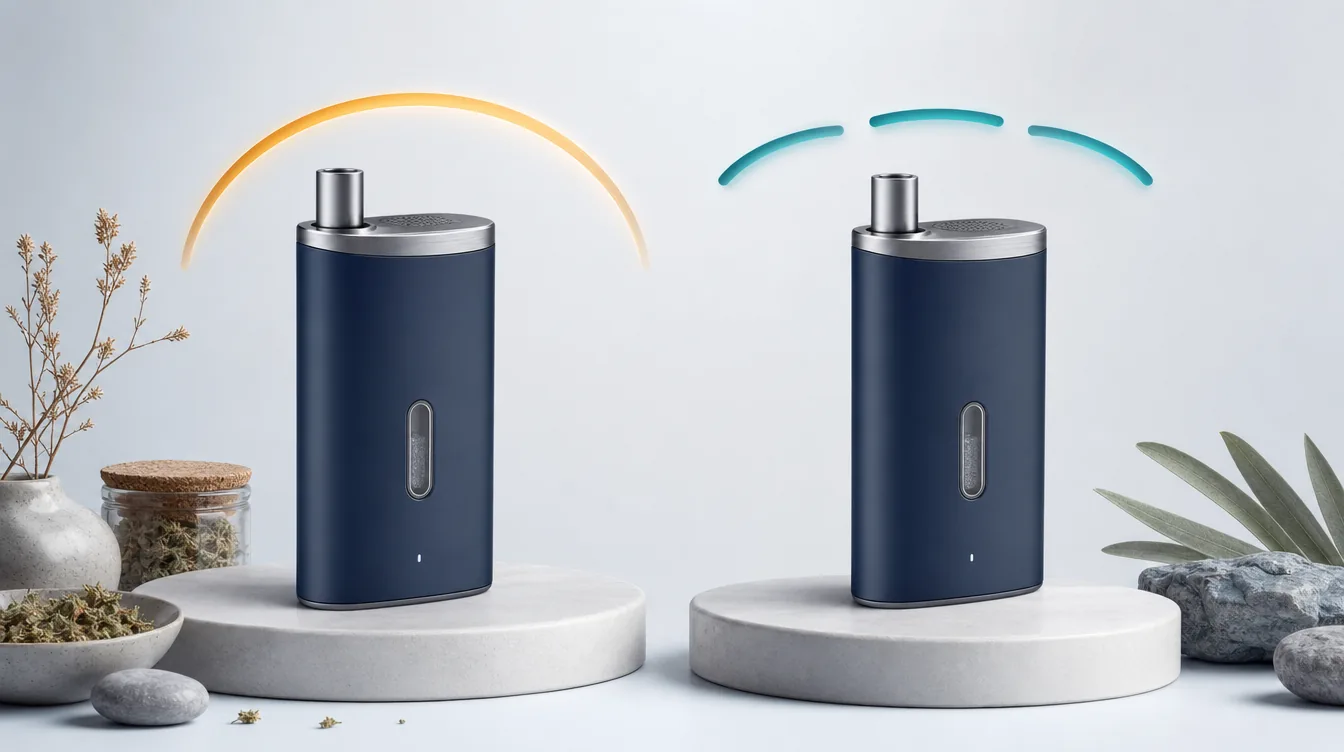
Two modes of operation, not two classes of active compound
In session mode, heating up, maintaining temperature and automatic shut-off are usually part of a single continuous sequence. The device can respond repeatedly to the target variable during this time. How much heat reaches the material between draws is a matter of design.
On-demand means that the heating request is triggered deliberately, for example by a button. The specific implementation can differ considerably. A brief activation impulse, a regulated draw mode and an externally pre-heated thermal storage system are technically distinct processes, even if they are occasionally described in similar terms commercially.
For any comparison it must therefore first be established what the respective product means by the term. Relevant factors are activation duration, ready signal, behaviour upon release, residual heat and automatic shut-off point. A generic label does not answer these questions.
Which mode suits which usage pattern?
| Question | Session mode | On-demand mode |
|---|---|---|
| Continuous use desired? | A fixed ready window can be convenient | Repeated activation may be required |
| Frequent interruptions? | Check actual keep-warm and shut-off behaviour | Check cooling after activation ends |
| Precisely defined single dose required? | Mode alone is not sufficient | Mode alone is likewise not sufficient |
| Battery consumption important? | Measure heating time and standby losses | Measure repeated heat-up cycles and power demand |
| Shared use? | Usage procedure and hygiene are separate criteria | Usage procedure and hygiene are separate criteria |
These are decision criteria, not clinically tested recommendations for specific groups of people. A device may offer both modes without having the same temperature or delivery characteristics in both.
Why switching off does not mean immediate cooling
The heating element is only one part of the thermal system. The chamber, metal parts, ceramic or glass can store heat. When the electrical power is switched off, their temperature does not instantly fall to room temperature. Some of the stored energy can continue to transfer into the filling.
How strongly this occurs depends on mass, material, contact surfaces and air movement. This is a technical explanation of possible residual heat, not a quantitative measurement of specific vaporizers. Without a device-specific protocol, neither a large loss nor complete absence of loss can be derived from this.
For a pause comparison one would need to define how long the pause lasts, whether the filling remains in the device, whether air flows through it and which fractions are collected. A measurement taken only after the next draw cannot automatically explain whether material was delivered, condensed or otherwise redistributed in the interim.
What is frequently missing from the term “saving material”
A material saving is a ratio between two comparable situations. Both require a defined objective. Is the same aerosol mass achieved, a subjectively similar perceived effect, or merely a similar cloud? These endpoints are not interchangeable.
A scientifically valid percentage figure would also need to control for flower batch, cannabinoid content, filling, temperature, draw behaviour and end of use. If one group uses its filling for longer or aims for a different effect, the gram figure alone is not a pure device effect.
The earlier incomplete reference to an alleged study in the Journal of Cannabis Research from 2024 cannot be assigned to any verifiable original within the provided pool of twelve sources. A percentage saving based on this is therefore not adopted. This is a source correction, not proof that every conceivable saving would be ruled out.
A filling, a draw and a dose are different things
The loading describes the mass filled in. Its cannabinoid content is an additional piece of information. Even if both are known, the quantity delivered by the device is not yet established.
The delivered dose refers to a defined point at the device. The inhaled quantity depends additionally on the inhalation process. The systemic exposure is investigated within the body. A figure in grams of plant material cannot substitute for these stages.
Hazekamp investigated the relationship between loading and delivery in the Volcano. The balloon measurement described in the full text shows why loaded and available quantity should be kept conceptually separate. It does not validate a fixed puff dose for arbitrary on-demand devices. [Hazekamp2006]
“One draw” is also not a standardised unit without duration and volume. A person may move a different volume of air for the same draw duration. Additionally, a partially extracted filling may behave differently from a fresh one. The number of draws therefore cannot be converted into milligrams of THC without validation.
What Carrara shows about delivery over time
The work by Carrara and colleagues examines how cannabinoids are delivered over a controlled sequence of draws. The models compared showed different profiles. This finding is important for the question of whether multiple draws from the same filling may be regarded as equivalent portions. [Carrara2020]
The answer cannot be derived from a simple mean value. If one were to divide a total quantity by the number of draws, one would obtain a calculated average quantity. That would not yet constitute evidence that each individual draw contains this quantity. A mean value can conceal a strongly varying profile.
The study does not, however, test any general superiority of session or on-demand. Its value lies in the method and in the model-specific delivery measurement. Transferring the finding to every current device with a similar operating label would be an additional, untested assumption.
What makes medical dose validation different
Almog and colleagues investigated a specific Syqe inhaler in a controlled study. Defined single inhalations and subsequent pharmacokinetic measurements were used. The device was part of the study protocol, not merely an interchangeable label. [Almog2020]
The work is therefore an example of the additional evidence a dosing claim requires. A consumer device does not become equivalent simply because it also heats at the press of a button. Equally, a small filling chamber does not in itself constitute clinically validated microdosing.
The study does not permit a general self-treatment instruction. Limitations on its conclusions arise from, among other things, patient selection, short observation period and manufacturer connections. The detailed study card also lists different analysis populations; a single sample size figure would obscure these differences.
Battery consumption: the mode label is not enough
A session device requires energy for heating up and, where applicable, for maintaining temperature. An on-demand device may require less power between activations but must repeatedly supply heat. How these components add up depends on the actual usage pattern.
A meaningful comparison requires a shared task: the same starting temperature, a defined activation sequence, identical ambient conditions and a clear endpoint. “Sessions per charge” is not comparable between devices without a definition of a session.
Battery capacity in milliampere-hours alone does not answer the question either. Voltage, usable charge range and system efficiency also play a role. The pool of studies does not provide a reliable current battery ranking; this article therefore contains no invented session figures.
Temperature display, ready state and actual delivery
A ready signal indicates that the device’s programmed condition has been reached. It need not mean that every point of the filling is at the same temperature. Particularly with intermittent activation, the time profile is important.
The comparison “five seconds to ready” versus “thirty seconds to ready” is only meaningful if the starting state and the definition of ready are known. The heat-up time of a cold device differs from a re-activation after a short pause.
Anyone checking product data should therefore consider cold start, reheating, and automatic shut-off separately. Scientific studies on an older model do not automatically substantiate the corresponding claims of a current successor. The heating methods and the temperature measurement points provide the technical background.
How a mode comparison can be documented in a transparent manner
First, the usage sequence is established: consecutive activations or defined pauses. Then the model, version, settings, and preparation are documented. Observable findings such as operating time or condensate are distinguished from unmeasured compound delivery.
If a comparison is based on subjective impressions, this must remain apparent. Expectations, order of testing, and prior tolerance can influence the assessment. A personal preference is useful, but is not independent laboratory evidence.
A published test should also state the limitations of the trial. Two devices tested initially permit a statement about those two devices. Multiple draws from a single load are dependent measurements. Repetitions under different conditions can test robustness, but must not be retrospectively reformulated into a universal claim.
Why an average per draw does not resolve the dosing question
A purely arithmetical example illustrates the difference: suppose a hypothetical draw sequence delivers a known total quantity. Dividing by the number of draws would yield an average quantity. However, the same total could arise from very similar individual quantities as well as from one large early delivery followed by several smaller later ones. The example contains no measured vaporizer data.
For dosing precision, at least the individual quantities and their variance would therefore be relevant. Additionally, it would need to be established whether the pattern repeats with a fresh load. A well-reproducible total sum can be compatible with highly variable individual draws.
Even a consistently repeated activation input does not constitute complete control. The thermal starting state may differ after a brief pause compared to full cooling. If the device does not record or validate a defined delivered quantity, an identical button press initially remains only an identical operating action.
Two independent questions for a product test
Usability: Can the sequence be clearly started, paused, and ended? Is the ready signal comprehensible? Are residual heat and safe storage explained in the instructions? These questions can be answered in a technical product review.
Dose delivery: What quantity of compound is released under defined conditions, how much does it vary, and how does it change over time? These questions require chemical or device-specific validation. For systemic exposure, human measurements are additionally required.
A test can be well documented on the first question and open on the second. This is useful information. It only becomes problematic when easy operation is reinterpreted as precise medical dosing without corresponding evidence.
Supplement from the terpene audit
The device and method sources cited above were retained during the consolidation of the current article version. The following sections supplement the separate terpene audit with targeted source verification. Neither literature selection is a systematic comprehensive search.
Which device examples are substantiated by manufacturer specifications?
Arizer explicitly describes Session and On-Demand mode for the Solo III. The specific selection and operation are documented on the manufacturer’s support page. This information substantiates the available modes; it is not evidence of a particular level of medical dosing accuracy.
For the VENTY, STORZ & BICKEL describes a combination of convection and conduction as well as regulation with reference to airflow. The technical manufacturer overview is the appropriate reference for this. The earlier description as a device with two explicitly selectable modes — Session and On-Demand — has been removed.
Likewise, unsubstantiated claims about replaceable batteries, general session counts, and static shop figures have been removed from the previous comparison. A scientifically explanatory article should not use such variable product data as evidence for a heating concept.
How can the appropriate operating procedure be assessed?
Consider which operation suits your intended use: longer consecutive operating phases or clearly bounded activations. Pay attention to comprehensible signals, accessible controls, automatic shut-off, and safe storage of hot components.
Also consider cleaning and configuration. Additional capsules or cooling components can alter the behaviour. A comparison of two modes is only transparent if the remaining conditions are described.
The article on heat-up time supplements the time measurement; Conduction, Convection and Hybrid explain the heat pathways. Together these details provide a better basis than a blanket winner label.
Frequently Asked Questions
Does On-Demand only heat during a draw?
No. The type of activation is device-specific. On-Demand can also be triggered by a button or a time-limited sequence.
Is there immediately no heat remaining after switching off?
No. Stored heat initially remains in components and material. The mode describes active heating, not immediate complete cooling.
Is rapid heat-up the same as On-Demand?
No. Heat-up time and operating mode are distinct properties.
Can devices offer both modes?
Yes. Arizer documents this, for example, for the Solo III. The specific device version and instructions must correspond to the statement.
Is a fixed material or battery saving substantiated?
The general percentage ranges cited previously are not substantiated by the provided source package and have been removed.
Source status and corrections
As of: 10 September 2026. Device examples were verified against the directly linked manufacturer specifications. These serve as product descriptions and are not clinical studies. For general saving values, no suitable direct comparison is available in the provided terpene register.
Corrections were made to the mode confusion regarding the VENTY, the claim of immediate cooling, general percentage figures, and the equation of a brief heating phase with medical dosing precision.
Studies, sources, and limitations of findings
The study cards describe the respective experimental setup and its limitations.
Carrara2020: Laboratory study with a standardised puffing machine; DaVinci and Mighty Medic; Bediol flowers. No participants.
Carrara L, Giroud C, Concha-Lozano N. Development of a Vaping Machine for the Sampling of THC and CBD Aerosols Generated by Two Portable Dry Herb Cannabis Vaporizers. Medical Cannabis and Cannabinoids. 2020;3:84–93.
- Design and material/population
- Laboratory study with a standardised puffing machine; DaVinci and Mighty Medic; Bediol flowers. No participants.
- Sample units
- Distinguish between device models, loadings and technical replicates. Table 1 assigns the individual experimental series; six trials for the collector comparison in Table 2 are not six independent device populations.
- Measurement
- 150 mg finely ground flowers, 210 °C target temperature; five-second draws in 30-second cycles. Assessment of aerosol collection and temporal cannabinoid delivery.
- Finding
- The two models showed different delivery profiles. A model coefficient describes the extraction kinetics; it is neither bioavailability nor clinical efficacy.
- Uncertainty and transferability
- A single coefficient does not capture the full uncertainty of the device, plant material and draw behaviour. No ranking of all heating classes.
- Funding and interests/design notes
- No financial or competing interests declared; Storz & Bickel provided the Mighty Medic.
- Specific source location
- Pp. 86–88: Materials and Methods, Tables 1–2; pp. 89–91: Results and delivery model; p. 92: Acknowledgements/Disclosure.
- Review scope
- Relevant full-text passages reviewed on 10.09.2026.
Reviewed source · DOI: 10.1159/000505027
Almog2020: Randomised, double-blind, placebo-controlled crossover study of a Syqe inhaler in chronic pain patients.
Almog S et al. The pharmacokinetics, efficacy, and safety of a novel selective-dose cannabis inhaler in patients with chronic pain: A randomized, double-blinded, placebo-controlled trial. European Journal of Pain. 2020;24:1505–1516.
- Design and Material/Population
- Randomised, double-blind, placebo-controlled crossover study of a Syqe inhaler in chronic pain patients.
- Sample Units
- 27 randomised, 25 completing all sessions; 22 persons per treatment arm in the pharmacokinetic analysis. The denominators of the efficacy analyses differ.
- Measurement
- Single inhalations of 0.5 mg, 1 mg THC or placebo; plasma THC and acute endpoints up to 150 minutes.
- Finding
- An example of concretely validated dose delivery by a specific medical system. Not a test of the general consumer feature on-demand.
- Uncertainty and Transferability
- No general safe microdose can be derived. Small sample; according to the methods section, not registered at ClinicalTrials.gov due to an administrative error.
- Funding and Interests/Design Notes
- Several co-authors affiliated with Syqe Medical. The manufacturer connection must be taken into account when interpreting the findings.
- Specific Source Location
- Sections 2.1–2.3: design and device; Section 3 and Figure 1: analysis populations; author affiliations.
- Review Scope
- Relevant full-text passages reviewed on 10.09.2026.
Reviewed Source · DOI: 10.1002/ejp.1605
Hazekamp2006: Volcano laboratory validation with pure cannabinoids and plant material; supplementary measurement of exhaled THC.
Hazekamp A, Ruhaak R, Zuurman L, van Gerven J, Verpoorte R. Evaluation of a vaporizing device (Volcano) for the pulmonary administration of tetrahydrocannabinol. Journal of Pharmaceutical Sciences. 2006;95:1308–1317.
- Design and Material/Population
- Volcano laboratory validation with pure cannabinoids and plant material; supplementary measurement of exhaled THC.
- Sample Units
- Four devices; temperature trials conducted in triplicate, final device comparison with 4 mg THC performed five times per device. The brief report does not state an unambiguous total number of clinical participants.
- Measurement
- HPLC and quantitative NMR; predominantly 8-L balloon. Loading 2–8 mg pure THC. Temperature measured centrally in the filling chamber above the liquid pad. Loaded, delivered and exhaled quantities are recorded separately.
- Finding
- In the final device comparison, an average of 53.9 % of the loaded THC passed into the balloon. The trial also investigated condensation at the chamber, valve and balloon. The near-complete deposition on the analytical glass-fibre filter is not a finding relating to a water filter.
- Uncertainty and Transferability
- Recovery is protocol- and substrate-dependent, not a universal bioavailability figure. The supplementary clinical measurement did not include pulmonary function testing. No comparison with and without water filtration was made.
- Funding and Interests / Design Notes
- Devices from Storz & Bickel, plant material from Bedrocan; Farmalyse supported the preparation of clinical cannabinoid standards. No separate comprehensive declaration of interests was found.
- Specific Source Location
- Original pp. 1310–1312: Methods; pp. 1314–1315: delivery/condensation; p. 1316: Acknowledgements. Manufacturer copy with differing pagination additionally cross-checked.
- Review Scope
- Relevant full-text passages, methods and support statements verified on 10.09.2026; previously abstract only.
Verified Source · DOI: 10.1002/jps.20574
Source review: 10 September 2026. Within the targeted pool of twelve primary works, eleven were verified against relevant full-text passages. For Van Dam 2010, accessible original sections were additionally checked beyond the abstract; a complete PDF and table review remains open. Additional literature cited in the article belongs to separate source reviews. No systematic comprehensive search.