Cannabis Botany: Trichomes and Cannabinoid Production
Introduction to Cannabis Botany
Cannabis is one of humanity’s oldest cultivated plants, with a history spanning over 10,000 years. Understanding cannabis botany is fundamental for any vaporizer user, as the plant’s characteristics directly influence the vaporization experience: from cannabinoid and terpene profiles to the physical structure of the plant material. This guide covers the botanical aspects of cannabis relevant to vaporization — taxonomy, morphology, life cycle, and the production of bioactive compounds released during vaporization.Taxonomy and Classification
Scientific Classification
- Kingdom: Plantae
- Division: Magnoliophyta (flowering plants)
- Class: Magnoliopsida (dicotyledons)
- Order: Rosales
- Family: Cannabaceae
- Genus: Cannabis
Species and Subspecies
The debate about cannabis species continues, but three types are generally recognized.
Cannabis sativa L. originates from equatorial regions and produces tall plants reaching up to 6 meters with narrow, elongated leaves. It has a longer flowering period and is traditionally associated with energizing effects.
Cannabis indica Lam. comes from mountainous regions like the Hindu Kush. These plants are more compact (1–2 meters) with wide, short leaves, and they flower faster than sativas. Indica is traditionally linked to relaxing effects.
Cannabis ruderalis Janisch. is native to northern regions. These small, hardy plants flower automatically regardless of light cycle — a trait called autoflowering. Their cannabinoid content is low, so ruderalis is mainly used in breeding programs to introduce the autoflowering characteristic into other strains.
Modern Hybrids
Most cannabis grown today consists of hybrids combining genetics from different types. Sativa-dominant strains carry 60–90% sativa genetics, while indica-dominant hybrids contain the same proportion of indica genes. Balanced hybrids sit around 50/50. Autoflowering hybrids incorporate ruderalis genetics to flower regardless of light schedule.
Plant Morphology
Root System
Cannabis develops a strong taproot that grows vertically downward. Secondary roots branch out laterally, and their fine root hairs absorb water and nutrients from the soil.
Stem
The stem is hollow with fibrous walls, serving both nutrient transport and structural support. Cannabis fibers have been used historically for ropes and textiles — a legacy that continues in the modern hemp industry.
Leaves
Cannabis leaves are palmately compound, consisting of 3 to 13 leaflets per leaf (always odd-numbered). The leaf margins are serrated with visible teeth. Seedlings display opposite leaf arrangement, which shifts to alternate phyllotaxy as the plant matures. Trichomes appear on leaves as well, though at a lower density than on flowers.
Flowers
Flowers are the most relevant part of the plant for vaporization.
Female flowers (buds) form dense clusters covered with glandular trichomes. They contain the highest concentration of cannabinoids and terpenes. The pistils (stigmas) start out white and turn orange to red as the plant matures. When left unpollinated, female flowers produce more resin — this seedless cannabis is known as sinsemilla.
Male flowers form hanging clusters of small blossoms that release pollen. Their cannabinoid content is low, and they are generally discarded for consumption.
Trichomes: Cannabinoid Factories
Trichomes are microscopic structures on the plant surface that produce and store cannabinoids, terpenes, and flavonoids.
Trichome Types
Capitate-stalked glandular trichomes are the largest at 50–100 µm diameter and contain the highest cannabinoid concentration. Visible to the naked eye as sparkling “crystals,” they consist of a spherical head sitting on a visible stalk.
Capitate-sessile glandular trichomes are smaller and lack a visible stalk. They are found across flowers and sugar leaves.
Bulbous glandular trichomes are the smallest at 15–30 µm. They occur throughout the plant but contribute only a small share to the total cannabinoid content.
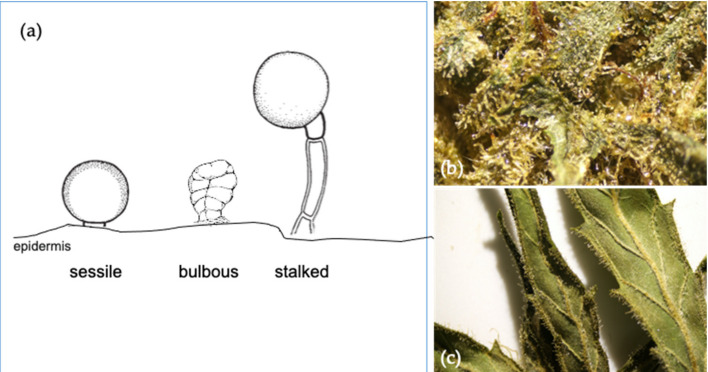
Trichome Maturation
Observing trichomes indicates optimal harvest time:
| State | Appearance | Indication |
|---|---|---|
| Clear/transparent | Translucent heads | Underdeveloped, immature cannabinoids |
| Milky/cloudy | Opaque white heads | Peak THC, optimal harvest |
| Amber | Yellowish/orange heads | THC degrading to CBN, more sedative |
These three stages are best observed with a pocket microscope at 60–100× magnification. Clear, translucent trichome heads indicate immature material with lower cannabinoid content. The milky-white cloudiness signals peak THC production and the ideal harvest window. Once the heads turn amber, THC is increasingly converting to CBN, which produces more sedative effects. Many growers harvest at roughly 70% milky to 30% amber.
Environmental Factors
Several environmental factors drive trichome production. UV light stimulates trichome development as a protective response by the plant. Day-night temperature differentials encourage resin production. Controlled stress — such as briefly withholding water — can also boost cannabinoid concentration.
Cannabinoid Biosynthesis
The Biosynthetic Pathway
Cannabinoids are synthesized in glandular trichomes:
- Precursors: Olivetolic acid + GPP (geranyl pyrophosphate)
- CBGA: Cannabigerolic acid (“mother” cannabinoid)
- Specific enzymes: Convert CBGA to:
The process starts with olivetolic acid and GPP (geranyl pyrophosphate) as precursors, which combine to form CBGA (cannabigerolic acid) — the so-called “mother cannabinoid.” Specific enzymes then convert CBGA into THCA (tetrahydrocannabinolic acid), CBDA (cannabidiolic acid), and CBCA (cannabichromenic acid). Only through decarboxylation — the application of heat — are these acidic forms converted into the active cannabinoids THC, CBD, and CBC.
- Decarboxylation: Heat converts acid forms to active ones (THC, CBD, CBC)
Factors Influencing Production
Cannabinoid production depends on multiple factors. Genetics set the ceiling for potency and determine the ratios between individual cannabinoids. Light intensity and spectrum affect resin output — UV-B radiation in particular appears to promote trichome formation. Controlled stress can increase trichome production, while nutrient deficiencies or excesses reduce quality. Finally, harvest timing shapes the final cannabinoid profile: early harvests yield a different effect spectrum than late ones.
Terpenes: Aromas and Effects
Terpene Production
Terpenes are synthesized from isoprenoid precursors in the same glandular trichomes that produce cannabinoids. Researchers have identified over 200 different terpenes in cannabis so far. These compounds are highly volatile and sensitive to light and heat, which matters for both storage and vaporization temperature selection. Terpenes originally evolved as the plant’s defense against pests and herbivores.
Main Terpenes
| Terpene | Aroma | Suggested Effects |
|---|---|---|
| Myrcene | Earthy, musky | Relaxing, sedative |
| Limonene | Citrus | Mood elevator |
| Pinene | Pine | Alertness, memory |
| Linalool | Lavender | Calming, anxiolytic |
| Caryophyllene | Pepper | Anti-inflammatory |
| Humulene | Hops | Appetite suppressant |
Cannabis Life Cycle
Germination Phase
Germination takes 1 to 7 days. The seed absorbs water, causing the radicle (primary root) to break through. Shortly after, the first leaves — the cotyledons — appear above the soil.
Vegetative Phase
The vegetative phase lasts 3 to 16 weeks depending on the growing method. During this time the plant grows rapidly in height, with stems and leaves gaining mass quickly. Cannabis needs at least 18 hours of light per day to stay in vegetative mode. The root system develops extensively, and toward the end of this phase the plant’s sex becomes visible for the first time.
Flowering Phase
Flowering begins when light exposure drops to 12 hours or less — autoflowering varieties flower independently of the light cycle. This phase lasts 6 to 14 weeks depending on genetics. Flowers and trichomes develop during this time, cannabinoid and terpene production peaks, and trichomes progressively ripen from clear through milky to amber.
Harvest and Post-Harvest
Harvest timing is guided by trichome maturity. Flowers are cut, trimmed, and separated from sugar leaves.
Drying takes 7 to 14 days in a controlled room at 18–22°C (64–72°F) and 55–65% humidity. Keeping the environment dark protects cannabinoids from degradation.
Curing follows over 2 to 8 weeks or longer in airtight containers. During this period, flavor and smoothness develop, chlorophyll breaks down, and moisture stabilizes to an optimal level.
Implications for Vaporization
Material Quality
Botanical knowledge helps in evaluating quality. High trichome density indicates more potent material. Trichome color reveals the maturity stage and thus the effect profile. Bud structure also matters — dense flowers vaporize differently than airy ones. A rich, layered aroma signals an intact terpene profile, while a faint or musty smell suggests degradation. Moisture content should sit between 55% and 62% for optimal vaporization.
Preparation for Vaporizing
Before vaporizing, the material should be ground to expose more trichome surface area. A medium grind provides the best airflow through the chamber. The material should be well-cured but not too old. For storage, airtight containers kept in a dark, cool spot work best — this preserves cannabinoids and terpenes as long as possible.
Genetics and Breeding
Modern Cannabis Breeding
Cannabis breeding has grown more sophisticated with the legalization wave. Modern breeders use selective techniques to optimize specific cannabinoid and terpene profiles for targeted therapeutic or recreational effects. Breeding goals include higher yields, disease resistance, and specific cannabinoid ratios.
The future lies in genomics and marker-assisted selection. These methods allow faster, more precise development of new strains with targeted property profiles. Researchers are working to identify the specific genes responsible for producing individual cannabinoids and terpenes.
Conclusion
Understanding cannabis botany enriches the vaporization experience. From taxonomic classification to cannabinoid biosynthesis in trichomes, every aspect of the plant influences what we ultimately vaporize.
Knowing the plant enables better material selection, a deeper understanding of strain differences, optimized storage and preparation, and an appreciation for the complexity of a plant that has been part of human culture for millennia. Modern vaporization technology lets us tap into that complexity with scientific precision.
Scientific Sources
- Sommano, S. R. et al. (2020). The Cannabis Terpenes. Molecules, 25(24), 5792. DOI
- Livingston, S. J. et al. (2020). Cannabis Glandular Trichomes Alter Morphology and Metabolite Content During Flower Maturation. The Plant Journal, 101(1), 37–56. PubMed 31469934
- Zager, J. J. et al. (2019). Gene Networks Underlying Cannabinoid and Terpenoid Accumulation in Cannabis. Plant Physiology, 180(4), 1877–1897. PubMed 31138625
Related Articles: Boiling Points · Extracts · Microdosing · Best Convection Vaporizers
Frequently Asked Questions
What are trichomes?
Trichomes are hair-like glands on the surface of cannabis that produce resin containing all active compounds — over 100 cannabinoids and 200+ terpenes.
When are trichomes ripe?
Trichomes are ripe when they change from clear to milky-white — indicating peak THC content. Amber trichomes show decreasing THC and increasing CBN.