DynaVap Accessories & Upgrades
Buying a DynaVap is just the beginning. What comes after is where the real fun starts for many users. Few vaporizer systems offer as many customization options as DynaVap. Stems made of titanium, wood or glass. Different tips and caps. And of course induction heaters that make the lighter obsolete.
But with so much accessories available, it’s easy to lose track. What makes a real, noticeable difference? What’s nice-to-have? And what’s just burning a hole in your wallet?
We’ve taken a close look at the most popular upgrades. Current prices for all products mentioned can be found on vapochecker.com — Europe-wide, across 77 shops in 23 countries.
Why Upgrade? The DynaVap Building Block System
DynaVap has been built around modularity from day one. Every device consists of the same core components: tip, cap, stem. These parts can be freely combined, swapped and replaced. That makes DynaVap the Lego system of vaporizers.
An M Plus or M7 works flawlessly out of the box. Still, there are good reasons to upgrade:
- Better vapor cooling: Aftermarket stems with cooling fins or a vortex system deliver noticeably cooler vapor
- Faster heat-up: A titanium tip heats up quicker than stainless steel
- More comfort: An induction heater replaces the lighter entirely
- Looks and feel: Wood, glass or machined stainless steel feel different from the stock stem
If you’re interested in getting started with the DynaVap universe, our butane vaporizer buying guide provides orientation.
Stems and Bodies — Where the Upgrades Begin
The stem is the part you hold in your hand. And it has a surprisingly large influence on vapor quality. Cooling, draw resistance, weight — it all comes down to the stem.
Simrell — The Premium Tier
Simrell has become synonymous with high-end DynaVap stems. The US-based company manufactures CNC-machined metal stems with a proprietary cooling system. The result is noticeably cooler, smoother vapor compared to the stock stem.
Simrell MVS (Modular Vortex System)
The MVS is Simrell’s current flagship. It consists of interchangeable segments — you can adjust length and cooling to your preference. The build quality is impeccable. Once you’ve held an MVS, you won’t want to go back to the stock stem. Price-wise, it runs around €130–180 depending on the finish.
Simrell FMJ (Full Metal Jacket)
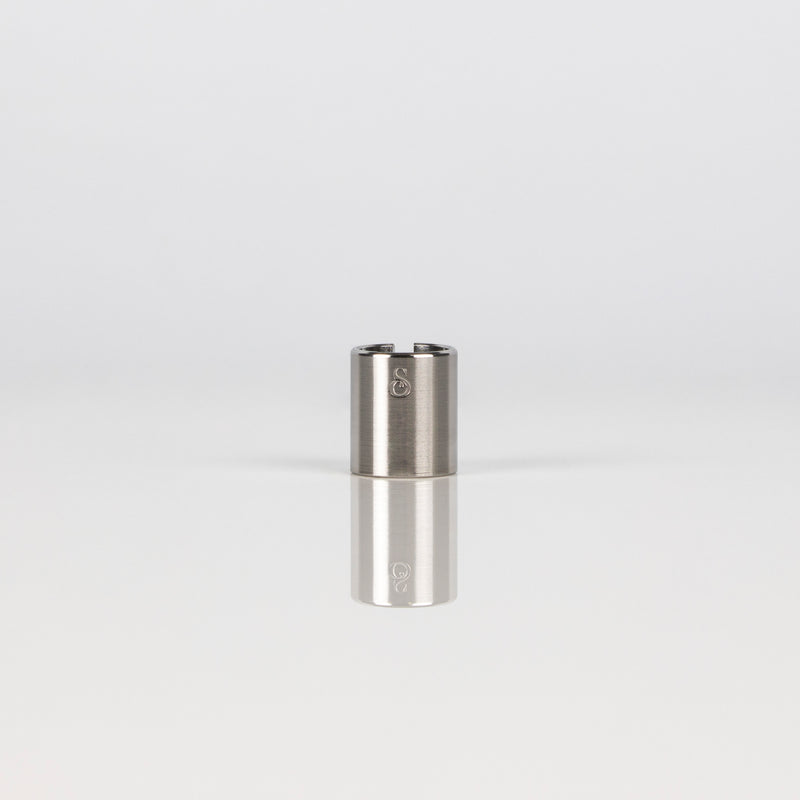
The FMJ isn’t a stem but a sleeve that fits around the DynaVap tip. The stainless steel cooling fins dissipate heat faster and produce cooler vapor. The advantage: you keep your existing stem and still get better cooling. One of the more affordable Simrell products.
The classic that started it all. The Vortex system creates a spiral airflow inside the stem. This gives the air more contact surface and cools it down before reaching your lips. Works well, though it’s been partially superseded by the MVS.
The Stinger is the entry point into the Simrell world. A compact condenser with vortex cooling that inserts into your existing stem. For around €40–60, you get a noticeable difference in vapor temperature. If you want to test whether Simrell is for you, start here.
Simrell Titanium Shorty Vortex
The short version in titanium. Lighter, more compact, ideal for on the go. If you like to carry your DynaVap in your pants pocket, you’ll appreciate the shorter form factor.
Wood Stems
Beyond Simrell, there’s a whole range of wood stems — partly from DynaVap itself (Omni, older models), partly from third-party makers like Ed’s TNT or cocobolo woodturners. Wood feels warm, doesn’t get hot in the hand and simply looks great.
Downside: wood is more delicate than metal. Isopropyl alcohol attacks the surface. Cleaning works best dry or with warm water.
Glass Stems
Glass stems from manufacturers like GRAV or DDave offer an entirely different experience. You can see the vapor, the flavor is clean, and longer glass stems provide excellent cooling. The obvious downside: glass breaks. Not for on the go, but at home on the desk, definitely appealing.
Tips and Caps — The Details That Matter
Titanium Tip vs. Stainless Steel Tip
DynaVap offers tips in two materials. The differences are real, even if more subtle than with stems.
Titanium heats faster and cools faster. That means shorter wait times between draws and a slightly different click behavior. Some users swear by titanium, others barely notice a difference. If you use your DynaVap daily, you’ll appreciate the speed advantage.
Cap Variants
The cap — the cover with the click mechanism — comes in several versions:
- Standard Cap: The classic. Clicks reliably, fits all tips.
- Captive Cap: Has small notches that prevent the cap from sliding off the tip. Particularly practical when heating over an IH.
- Low-Temp Cap: Clicks at a lower temperature. The result is more flavorful, less dense vapor. Great for flavor chasers who enjoy vaping at low temperatures.
Caps are wear parts. After a few hundred cycles, the click can become unreliable. A new cap costs around €10–15 and restores the click precision.
Induction Heaters — The Biggest Upgrade of All
If there’s one accessory that fundamentally changes the DynaVap experience, it’s the induction heater (IH). Instead of fiddling with a lighter, you insert the DynaVap into a coil, press a button, wait for the click and draw. Done.
How Does an IH Work?
A copper coil generates an alternating electromagnetic field. The metallic tip of the DynaVap is heated through eddy currents — contactless, even, reproducible. The principle is the same as an induction cooktop.
Advantages Over the Torch Lighter
- Even heating: No guessing where to aim the flame. The IH heats the tip uniformly all around.
- Reproducible results: Every session turns out practically identical. The variability of the lighter is gone.
- No butane gas needed: Charge instead of refill. Especially true for portable IH models with batteries.
- More discreet: No open flame, no fire, no suspicious appearance.
- One-handed operation: Insert DynaVap, press button, wait, draw.
Disadvantages
- Price: Good IH units cost between €80 and €200. A jet lighter costs €5.
- Less control: If you enjoy experimenting with different heating points (near the tip, middle, near the cap), you lose that option.
- Weight and size: Portable IH units are portable, sure, but they don’t compare to a lighter in your pocket.
Recommended IH Models
Currently one of the most popular portable IH units. Dual 21700 batteries deliver between 30 and 100 watts of adjustable power. Build quality is solid, battery life lasts for dozens of sessions. Depending on the configuration, prices range from 49 €–180.
Another established manufacturer with various models for home and on-the-go use. The desktop variants are particularly popular for their reliability.
Compact, lightweight, well-built. The VHB Carbon is one of the most portable IH units on the market. A good option if you travel a lot.
Caldwell
Caldwell heaters come from Canada and are known for their rugged construction. On the pricier side, but built to last.
For the technically inclined, building your own IH is also an option. The community shares build guides, and the required components cost significantly less than a finished product. That said: without experience in electronics, it’s best to leave it alone.
Other Accessories
DynaStash and SlimStash
DynaVap’s own storage solutions made from wood. The DynaStash holds the vaporizer plus a portion of material. The SlimStash is slimmer and fits in a pants pocket. Both have a magnet that holds the cap — handy when loading.
Also available from third-party makers in various materials and sizes. Ultimately, you only need something like this if you regularly transport your DynaVap.
DynaCoil — Vaping Concentrates
The DynaCoil is a stainless steel coil that inserts into the tip. It allows you to vaporize waxes and concentrates. It works, but it’s no replacement for a dedicated concentrate vaporizer. More of a nice extra for occasional use.
WPA — Water Pipe Adapter
An adapter for connecting the DynaVap to a water pipe or bong. Water filtration cools the vapor further and makes the experience even smoother. If you vape at home and own a bong, give it a try. WPA adapters start at around €10. Combined with an IH, you get a setup that’s hard to beat in terms of comfort.
Upgrade Order — What’s Worth It and When
Don’t buy everything at once. The most sensible order looks like this:
1. First Upgrade: Captive Cap (~€10)
Small money, immediate comfort. The cap stays on the tip — no more dropping it during heating. If your DynaVap doesn’t have a captive cap, this is the most obvious first step.
2. Induction Heater (~€80–200)
The upgrade with the biggest impact on your daily routine. If you use your DynaVap regularly, you’ll notice the comfort improvement right away. The learning curve for torch heating disappears entirely.
3. Simrell Stinger or FMJ (~€40–80)
The Stinger brings vortex cooling at a low price point. The FMJ improves heat dissipation. Both make the vapor noticeably more pleasant without having to swap your stem.
4. Titanium Tip (~€30–45)
Faster heat-up, faster cool-down. Noticeable but not life-changing. Particularly worthwhile in combination with an IH.
5. Premium Stem — Simrell MVS or Vortex (~€130–180)
The top tier. If you still want more after everything else, get an MVS. The vapor quality reaches a level that makes the DynaVap almost unrecognizable.
6. WPA + Bong (~€10–30)
The at-home setup. If you have a bong, try it. You don’t need it, but once you’ve tried it, you won’t want to go without.
Price Overview — What Do the Upgrades Cost?
All prices listed are approximate and vary by shop, country and availability. Daily-updated prices can be found on vapochecker.com — we compare across 77 shops in 23 European countries.
Conclusion
The DynaVap ecosystem is one of the most versatile in the entire vaporizer market. You can start with an M Plus for under €80 and upgrade piece by piece over the years. Or you buy a HyperDyn right away and build from there.
The most important tip: don’t buy everything at once. A captive cap and a Stinger cost under €70 together and make a clear difference. Once you realize the DynaVap has become your daily driver, the induction heater makes sense. And eventually you’ll find yourself standing in front of the Simrell lineup wondering whether you really want to spend €160 on a stem. The answer is usually: yes.
Comparing prices is especially worthwhile for premium accessories. The differences between shops can easily reach €20–30 for Simrell products.
Last updated: February 2026. Prices and availability may vary by shop.
Price History: Simrell Accessories